Microsoft Dynamics 365 Supply Chain Management

With Microsoft Dynamics 365 Supply Chain Management, you can manage all your production and distribution processes. From purchasing and planning, to production, inventory management and logistics.
Within the cloud-based ERP and CRM platform Microsoft Dynamics 365, Supply Chain Management is a group of related modules that manages, optimizes and automates all of the processes around your supply chain. This yields benefits like real-time (or even predictive) insights throughout the value chain, better operational efficiency, and higher customer satisfaction. Combined with Dynamics 365 Finance, it offers a full-fledged ERP platform.
The main areas of Dynamics 365 Supply Chain Management (SCM) functionality are:
Microsoft Dynamics 365 Supply Chain Management gives you a wide range of tools in the area of purchasing and sourcing. From purchase process streamlining and improved cost management using collaborative portals, to contract management and purchasing analyses.
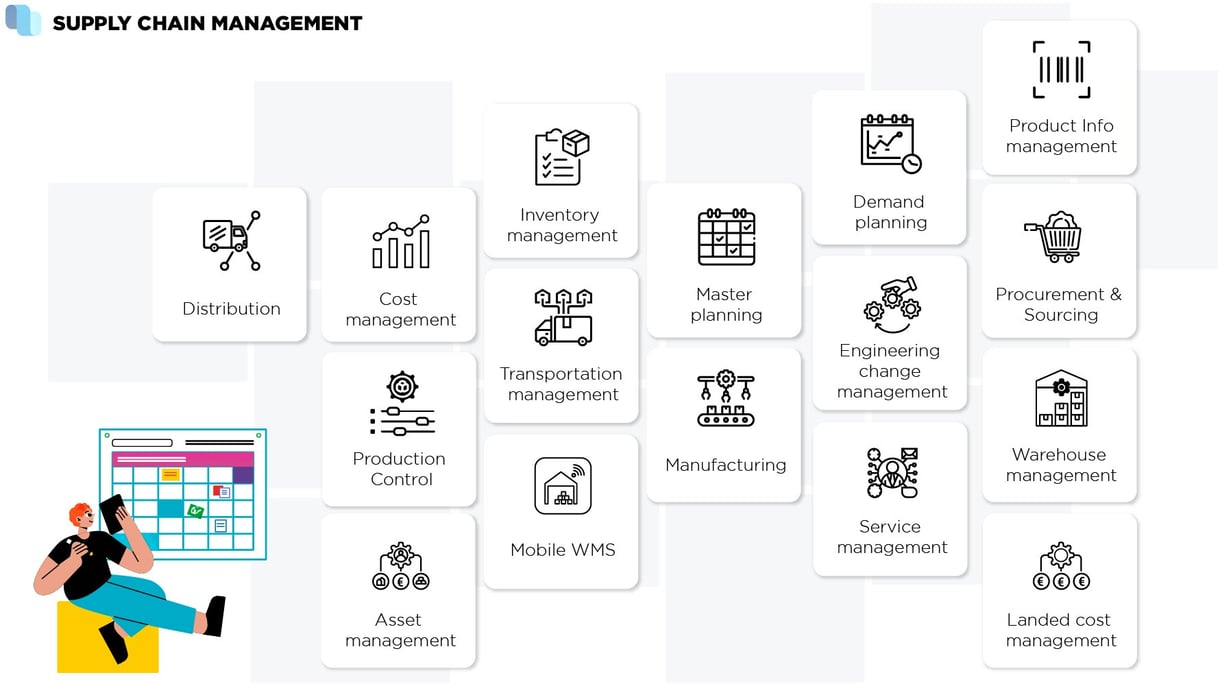
For production and production floor management, imagine a connected production floor with a real-time overview of your production and inventory, production order management, route management and management of production resources, such as employees, machinery, and other means of production.
Microsoft Dynamics 365 Supply Chain Management (SCM) lets you optimize and automate your entire order management process, from order receipt to delivery. Plus, this software supports complex pricing processes, such as price and discount management, pricing based on supply and demand, and price analyses.

SCM offers a wide range of functionality in warehouse management, from inventory optimization and warehouse process automation, to paperless stocking and picking, and integration with robotic process automation.
Maintenance and asset management
You can also use SCM to optimize and automate maintenance and asset management. Some key functions here include asset entry and tracking, predictive maintenance, and the execution and management of maintenance work orders.
Integrated machine learning and algorithms enable far better customer demand forecasting, so you can tailor your inventory levels to your actual needs.
As an all-in-one solution, SCM brings together all data, including IoT data from logistics and production processes. This way you can generate real-time, predictive insights in the areas of order processing, planning, purchasing, production, inventory, warehousing, and transport. Microsoft Dynamics 365 is modular, making it easy to tailor your cloud platform functionality to your organization’s needs and desires. Finally, it’s easy to integrate Microsoft Dynamics 365 SCM – not only with other software from the Microsoft domain, like Microsoft Teams and Power Platform, but also with all the other modern systems and applications you use.
Some of the main benefits of Microsoft Dynamics 365 SCM are:
A single cloud platform to optimize and automate all your production and distribution processes
Thanks to the modular architecture of Microsoft Dynamics 365, SCM is easy to combine with other Dynamics apps like Finance, Sales and Customer Engagement
Because all data is saved in a single, centralized platform, you have one uniform source of truth for all your processes, departments, and locations.
Features like automation and real-time or even predictive insights allow you to improve your operating efficiency, profitability, and product quality.
That depends. Microsoft uses a subscription model for Dynamics 365. How much you pay depends on factors like the number of users, the functionality those users need and whether you have a one-month, one-year or three-year contract. Want an idea of what Dynamics 365 Supply Chain Management would cost for your organization? Please get in touch with our Conclusion MBS advisers. To learn more about the licensing model, please visit the license page.
What does Microsoft Dynamics 365 Supply Chain Management cost?

That depends. Microsoft uses a subscription model for Dynamics 365. How much you pay depends on factors like the number of users, the functionality those users need and whether you have a one-month, one-year or three-year contract. Want an idea of what Dynamics 365 Supply Chain Management would cost for your organization? Please get in touch with our Conclusion MBS advisers. To learn more about the licensing model, please visit the license page.

Learn more about Microsoft Dynamics 365 Supply Chain Management?
Please email or call Richard.